
What organizations must redesign — and in what order
The diagnosis is clear.
Eight parts. Eight shifts — in how work moves, how decisions are made, how authority is distributed, how humans are repositioned, how planning transforms, how optimization erodes what it cannot measure, how organizations drift into something they did not choose to become.
The picture is coherent. The argument is complete.
Now someone in the room asks the question that has been building since Part 1.
So what do we actually do?
It is the right question. It is also, in most organizations, where the process goes wrong.
Not because the will to act is absent. Not because the diagnosis hasn't landed. But because the instinct — in leadership teams, in transformation programs, in AI strategy documents — is to start with what is visible.
Restructure the org chart. Redesign the planning process. Launch an AI governance committee. Create new roles with new titles that signal the organization is taking this seriously.
Each of these feels like progress.
None of them is the right starting point.
Because visible changes built on an unredesigned foundation do not fix the underlying mismatch. They produce a more sophisticated version of it.
New workflows that optimize toward a direction that was never defined.
New governance structures that monitor for drift from a strategic intent that was never encoded.
New roles designed for a system whose decision rights were never properly specified.
Six months into the transformation, the organization finds itself with better-looking problems than the ones it started with.
The mistake is not ambition.
It is sequence.
What to redesign matters.
The order in which you redesign it matters more.
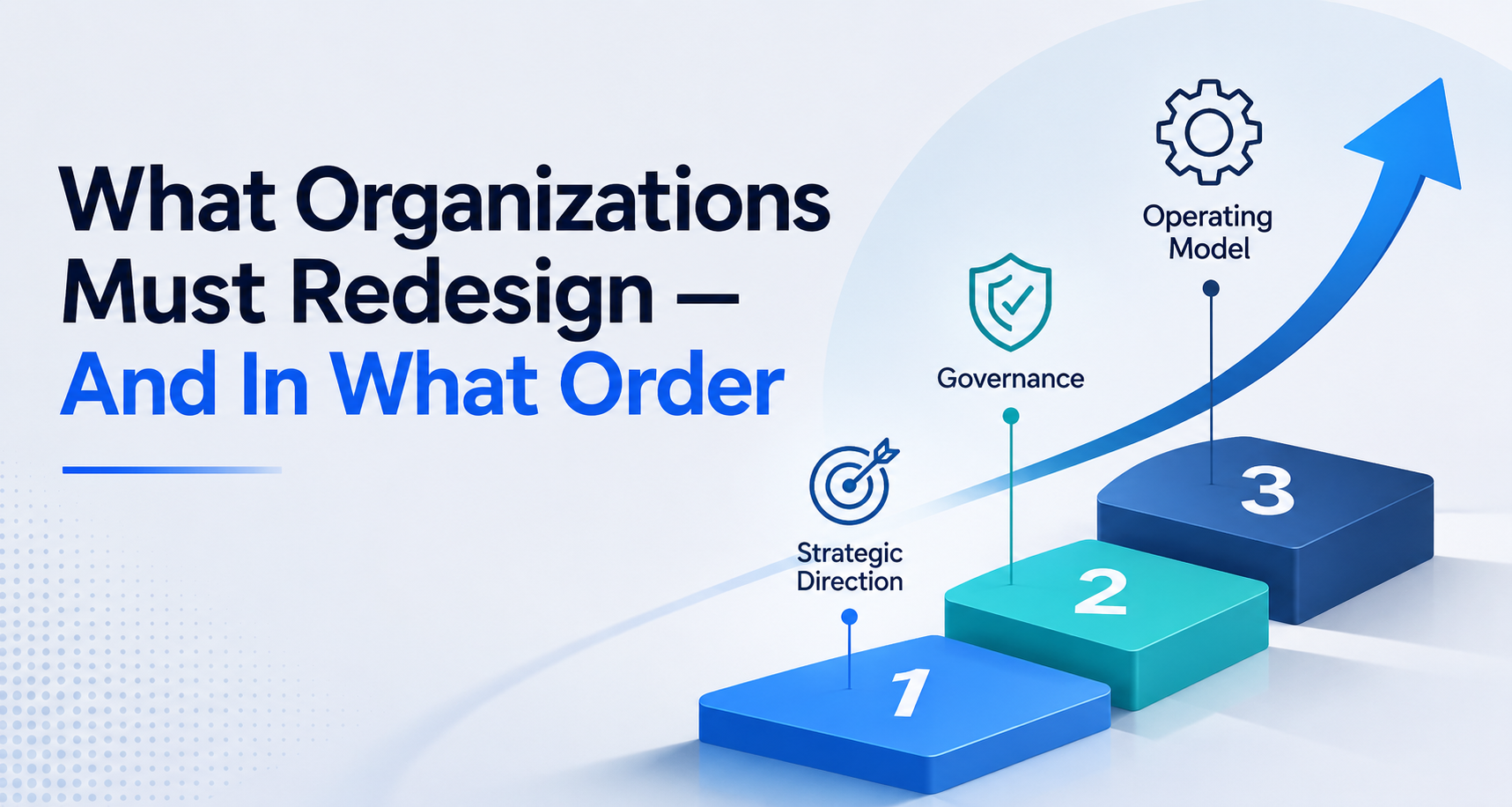
Because in a connected redesign — one that reaches from strategic direction through governance through operating model — each layer creates the conditions the next layer requires.
Get the sequence right, and each decision unlocks the next.
Get it wrong, and the redesign produces drift of its own.
This part is about the sequence.
1. Why you cannot layer agents onto old organizations
The instinct is to add.
Add an AI layer to existing workflows. Add a governance function to existing structures. Add new roles alongside existing ones. Add automation to the parts of the process that seem most repetitive, most time-consuming, most amenable to being handled without human involvement.
The instinct is understandable.
Adding is faster than redesigning. It is less disruptive. It produces visible results quickly — efficiency gains that can be reported, time savings that can be quantified, capabilities that can be demonstrated in a leadership review.
And in the short term, it works.
Processes get faster. Outputs increase. The organization looks, from the outside, like one that has successfully adopted AI.
But underneath, something is misaligned.
Because agent systems do not slot into organizational structures designed for human coordination. They do not simply accelerate the existing model. They change the underlying logic of how work moves — and that change creates a mismatch with every structure that was built on the old logic.
The mismatch is not always immediately visible.
But it is structural. And it compounds.
Consider what the old logic assumed.
Work moved because people moved it. Decisions required a human present — to initiate, to judge, to approve, to advance. Authority was exercised at moments — in meetings, through sign-offs, via the visible acts of judgment that made organizational life legible.
Every structure built on that logic reflects those assumptions.
Workflows are designed around human handoffs — sequential steps, each requiring a person to complete before passing to the next.
Decision rights are specified for roles — authority assigned to titles, exercised episodically, accountable to a hierarchy that assumes humans hold the decisions they are responsible for.
Planning cycles are built for periodic construction — direction set in advance, executed in sequence, reviewed at defined intervals by people who compare what happened against what was planned.
Accountability models point to individuals — because individuals were, by design, the mechanism. The person responsible for the outcome was the person who made the decisions that produced it.
These structures are not outdated because they were poorly designed.
They are outdated because the thing they were designed around has changed.
Layer agents onto these structures and the mismatch becomes operational.
The system operates in continuous time. The organization still thinks in periodic time — in quarters, campaigns, planning cycles that assume the world will hold still long enough for the plan to be right.
The system makes decisions continuously. The org chart still assigns accountability to people who are nominally responsible for outcomes they did not produce and cannot fully see.
The system optimizes toward its objectives. The organization has no mechanism to govern what it optimizes toward — because governance was never built into the architecture. It was assumed to exist in the hierarchy.
The system adapts its behavior based on signals. The workflows it operates within were designed for humans who adapted their behavior based on conversation, negotiation, and judgment.
Each of these mismatches is manageable in isolation.
Together, they produce an organization that is running two operating models simultaneously — one designed for human coordination, one emerging from system logic — without the coherence that either model requires to function well.
The result is not the worst of both worlds.
It is something more insidious: the appearance of transformation with the reality of compounded drift.
This is why layering fails.
Not because the agents are incapable. Not because the organization lacks the talent or the will to make this work.
But because you cannot redesign the surface without redesigning the foundation.
And the foundation — the underlying logic of how decisions are made, how authority is distributed, how accountability is assigned, how direction is maintained — was built for a model that agent systems have already changed.
The question is not whether to redesign.
It is what the foundation actually consists of.
And what order to rebuild it in.
2. The three layers of redesign
Redesigning an organization for agent systems is not a single intervention.
It is a sequence of connected decisions — each one operating at a different level of the organization, each one creating the conditions the next layer requires.
There are three layers.
And they have to be addressed in order.
Layer 1: Direction.
What the organization is building. What it will protect. What trade-offs are authorized — and which require human judgment regardless of what the system recommends.
This is the foundation.
Not because it is the most urgent thing on the leadership team's agenda. Often it is not. It feels abstract compared to the operational pressure of workflows that need fixing and governance committees that need standing up.
But it is foundational in a precise sense: every other layer depends on it.
Governance without direction is process without purpose — a mechanism for monitoring drift from a strategic intent that was never defined clearly enough to drift from.
An operating model without direction optimizes efficiently toward the wrong thing — faster execution of a journey whose destination was never specified.
Culture without direction adapts to the system's logic by default — because the system's logic is the only consistent signal available.
Direction is not a vision statement.
It is a set of answers specific enough to encode — precise enough to give a system something to operate within, and precise enough to give humans something to govern against.
Most organizations have not yet achieved that precision.
Which is why most redesigns, however well-intentioned, produce a more capable version of the same drift.
Layer 2: Governance.
The decision rights, accountability models, and oversight mechanisms that keep the system connected to direction as it operates.
Governance is built second — not because it is less important than direction, but because it cannot be built without it.
Governance answers three questions that direction makes answerable.
Who decides what — and at what level of the system versus at what level of human judgment? Which decisions are authorized to live inside the system, made continuously without review? Which require escalation? Which require a human regardless of what the system recommends?
Who is accountable for what — and where does accountability actually sit when decisions are made by systems rather than people? Accountability cannot remain pointed at individuals who no longer hold the decisions they are responsible for. It needs to be relocated — to the people who design the system's direction constraints, define its boundaries, and maintain its governance logic over time.
How does the organization detect and correct drift — before it compounds into something that takes years to reverse? This is the System 2 layer from Part 8: the designed capability for evaluating the pattern of system decisions, not just individual outputs.
Without governance, direction is aspiration.
With governance, direction becomes operational.
Layer 3: Operating model.
The workflows, roles, planning cycles, and coordination mechanisms that reflect how work actually moves in an agent-driven organization.
This is the layer most organizations address first.
It should be addressed last.
Not because workflows and roles are unimportant — they are what people experience every day, and getting them right matters enormously. But because they are downstream of the layers above them.
A workflow is an expression of a decision right. Design the workflow before the decision right is clear, and the workflow will encode the wrong assumption about where judgment lives.
A role is an expression of an accountability model. Define the role before accountability has been redesigned, and the role will inherit the mismatch it was supposed to resolve.
A planning cycle is an expression of how direction is maintained. Rebuild the planning cycle before direction has been encoded, and the new cycle will plan efficiently toward a target that was never properly defined.
Operating model changes feel like transformation.
They produce transformation only when the layers beneath them have been addressed first.
The sequence is the argument.
Direction first. Because everything else is built on it.
Governance second. Because it makes direction operational.
Operating model third. Because it is the expression of the two layers beneath it — and only works when those layers are sound.
Most organizations reverse this order — or collapse all three into a single transformation initiative that addresses everything simultaneously and therefore addresses nothing foundationally.
The result is familiar by now.
A more sophisticated organization.
Drifting in a more sophisticated direction.
3. Redesigning direction
Direction is the hardest layer to redesign.
Not because it requires technical expertise. Not because it demands resources or infrastructure or a transformation program.
Because it requires a kind of organizational clarity that most leadership teams have spent years successfully avoiding.
Strategy documents are written to accommodate multiple interpretations. Vision statements are crafted to inspire without constraining. Priorities are listed without being ranked — because ranking them would require choosing, and choosing would mean that some things matter less than others, and saying that out loud creates conflict that feels unnecessary when performance is strong.
Vagueness is a feature of most strategy processes.
It is not compatible with system design.
Because a system cannot operate within a direction it cannot read. It cannot protect a trade-off that was never specified. It cannot flag drift from an intent that was never precise enough to drift from.
When direction is vague, the system does not pause and wait for clarity.
It fills the gap.
With what it can measure. With what produces signal. With what its optimization logic, absent any other instruction, naturally moves toward.
Which is how organizations end up with highly capable systems confidently executing a direction no one consciously chose.
Redesigning direction requires answering three questions that most organizations have left deliberately open.
What are we actually building over three to five years?
Not the version that fits on a slide. The version specific enough to tell a system what to protect when short-term signals are pointing elsewhere. The version that has been tested against pressure — against the scenarios where optimizing for this quarter conflicts with building for the next three years — and still holds.
What will we not sacrifice for short-term performance?
This is the question that reveals whether direction is real or aspirational. Every organization says it values brand health, long-term equity, customer trust. The test is whether those values have been specified as constraints — things the system must not trade away in pursuit of measurable performance — or whether they exist only as stated beliefs that the system has no mechanism to honor.
What trade-offs are acceptable under what conditions?
Every system makes trade-offs. The question is whether those trade-offs were authorized by leadership or produced by default. This requires specificity that is uncomfortable to achieve: not "we balance short-term and long-term" but "under these conditions, the system is authorized to prioritize short-term performance; under these conditions, it is not, and escalation is required."
Answering these questions is the work of direction redesign.
It is not a strategy offsite.
It is a series of decisions — specific, documented, and precise enough to encode — that give the system something real to operate within.
Three design decisions follow from that work.
Define strategic boundaries, not just objectives.
Objectives tell the system what to move toward.
Boundaries tell the system what it must not do in moving there.
Both are required. Most organizations specify only one.
A system given an objective without boundaries will find the most efficient path to that objective — including paths that trade away things the organization values but never encoded as protected. It is not making a bad decision. It is making the only decision available to it given what it was told.
Boundaries are not constraints on capability.
They are the conditions within which capability is authorized to operate.
An organization that has defined its strategic boundaries has not limited what its systems can do. It has specified where the system's judgment ends and human judgment begins — and that specification is itself an act of strategic clarity that most organizations have not yet achieved.
Specify authorized trade-offs explicitly.
This is the most uncomfortable design decision at the direction layer — and the most consequential.
Every system makes trade-offs continuously. Between efficiency and brand. Between short-term conversion and long-term consideration. Between local optimization and system-wide coherence.
Those trade-offs are either authorized or they are produced by default.
Authorized trade-offs are ones leadership has explicitly considered — examined the conditions under which they are acceptable, defined the limits beyond which they are not, documented the logic clearly enough that the system can apply it and a human reviewer can audit it.
Default trade-offs are ones the system made because no one told it not to.
The difference between these two is not visible in the output. Both produce a decision. Both produce a result.
The difference is whether the organization is in control of its own direction — or whether control has been quietly delegated to the optimization logic of a system that was never asked to carry it.
Set direction metrics alongside performance metrics.
Performance metrics tell you how the system is doing against its objectives.
Direction metrics tell you whether the system is moving toward what the organization actually intends — the slower, harder-to-measure things that performance metrics will not surface until the damage is already done.
Brand salience. Long-term consideration. The balance between activation and equity building. The accumulated indicators of whether the organization is building what it said it was building.
These need to be defined before the system is deployed.
Not derived from outputs after six months of operation. Not assembled in a strategy review when someone finally asks why the performance data looks fine and something still feels wrong.
Before.
Because direction metrics defined after deployment are defined in the shadow of what the system has already been producing — which means they are shaped, however subtly, by the system's logic rather than by the organization's intent.
Direction metrics defined before deployment are defined by the question that matters most:
What would tell us, a year from now, that we are building what we said we were building?
That question — answered specifically, documented clearly, reviewed continuously — is what keeps the system honest.
And it is the work that has to happen before any governance structure can be meaningful, before any operating model change can be coherent, before the redesign can be anything more than a more capable version of the drift it was meant to prevent.
4. Redesigning governance
With direction defined, governance becomes concrete rather than theoretical.
This sequence matters.
Governance built before direction is clear becomes a monitoring function without an anchor — a set of processes that track system behavior against a standard that was never precisely enough stated to be tracked against. It produces reports. It generates reviews. It creates the appearance of oversight without the substance of it.
Governance built after direction is encoded becomes something different.
It becomes the mechanism through which direction stays operational — the designed capability that keeps the system connected to what the organization intended as it acts, adapts, and accumulates decisions over time.
That is the distinction between governance as compliance and governance as control.
Compliance asks: is the system doing what it is supposed to do?
Control asks: is the system producing the outcomes we actually intended — and if not, what needs to change?
In an agent-driven organization, the second question is the one that matters.
And answering it requires three design decisions that most governance frameworks have not yet made.
Redesign decision rights around the new reality.
Decision rights in most organizations were designed for a world where humans made decisions.
They specify who can approve what — which roles hold authority at which levels, which decisions require sign-off from which positions in the hierarchy.
That specification assumes a decision is a discrete act. A moment. Something a human performs, that can be attributed, reviewed, and if necessary reversed.
In an agent-driven organization, most decisions are not discrete acts.
They are continuous outputs — produced by system logic, accumulated across thousands of optimization cycles, shaped by signals and thresholds and boundary conditions that were set long before the outcome they produced.
Decision rights designed for discrete human acts do not map onto this reality.
They need to be redesigned around three categories that reflect how decisions actually work in a system-driven model.
Decisions that live inside the system — authorized to be made continuously, at speed, without human review. These are the decisions where the system's judgment is trusted within defined boundaries, where human involvement would add latency without adding value, where the cost of slowing the loop exceeds the benefit of human oversight at that level.
Decisions that require human judgment regardless of what the system recommends. These are the decisions where the stakes, the complexity, or the strategic significance exceed what the system was authorized to resolve — where a human needs to be present not because the system cannot produce an answer, but because the answer carries consequences that require human accountability.
Decisions that are escalated when conditions cross defined thresholds. These are the decisions that live inside the system under normal conditions — but where the system is designed to pause, surface the situation, and wait for human direction when something changes that falls outside the parameters of its authorization.
These three categories are not operational details.
They are the new vocabulary of authority in an agent-driven organization.
And they need to be as deliberately and specifically designed as any organizational hierarchy — because they are, in effect, the hierarchy. The structure within which power is distributed and exercised. The map of where human judgment begins and system judgment ends.
Most organizations have not drawn that map.
They have deployed systems, watched decisions accumulate, and assumed that the existing hierarchy still holds.
It does not.
Drawing the map is governance work. And it cannot be done without the direction layer to draw it against.
Build accountability to match where decisions actually live.
Accountability in most organizations is pointed in the wrong direction.
Not because no one thought carefully about it. But because accountability was designed for a model in which humans made decisions — and the person responsible for an outcome was, by definition, the person whose judgment produced it.
In a system-driven model, that logic breaks.
The outcome is real. The accountability is nominal. The person whose name is on the result did not make the decisions that shaped it — the system did, based on direction constraints and governance logic that were set long before the outcome existed.
Accountability needs to be redesigned — not to remove human responsibility, but to locate it where it actually sits.
In an agent-driven organization, accountability follows design, not approval.
The person accountable for an outcome produced by a system is the person who designed the system's direction constraints — who specified what it was built to protect, what trade-offs it was authorized to make, what conditions would trigger escalation.
Not the person who approved the last campaign.
Not the person who reviewed last week's performance dashboard.
The person who made the upstream design decisions that determined, before the system ran, what the system was capable of producing.
This relocation of accountability is uncomfortable.
It requires naming, specifically, who owns the direction layer — who is responsible for ensuring that what the system is built to optimize toward still reflects what the organization actually intends.
In most organizations, that person does not currently exist.
The accountability sits in a gap between the technology team that built the system and the business team that uses its outputs — with neither side holding the design decisions that determined what the system would produce.
Closing that gap is not an HR decision.
It is a governance decision.
And it is one of the most consequential ones an organization can make.
Create the System 2 layer.
Fast systems need slow oversight.
This was the argument in Part 8 — and it becomes a concrete governance design decision in Part 9.
The System 2 layer is not a committee. It is not a quarterly review. It is not a compliance audit that checks whether the system followed its rules.
It is a designed capability — running continuously alongside the execution layer — that evaluates the pattern of system decisions rather than individual outputs.
The distinction matters.
Individual outputs can look correct while the pattern they form is drifting. Each optimization individually justified. Each reallocation responding to a real signal. Each decision within the authorized boundaries.
And collectively moving the organization somewhere it did not intend to go.
The System 2 layer catches what individual output reviews cannot — the accumulation, the trajectory, the slow divergence between what the system is producing and what the direction layer said it should be producing.
Three questions define what the System 2 layer needs to be able to answer.
Is the pattern of system decisions consistent with encoded direction — or has the optimization logic been quietly drifting toward what is measurable at the expense of what was specified as protected?
Are the trade-offs the system is making falling within authorized parameters — or have conditions changed in ways that require those parameters to be revisited?
Are the direction metrics moving in a way that reflects the intended trajectory — or are there leading indicators of drift that the performance metrics will not surface for another two quarters?
Designing the System 2 layer requires answering four practical questions.
Who runs it? This cannot be the same team that operates the System 1 layer — the conflict of interest is too direct. The team responsible for optimization performance cannot also be the team responsible for evaluating whether optimization is taking the organization in the right direction.
At what cadence? Frequently enough to catch drift before it compounds. Infrequently enough to evaluate patterns rather than noise. The right cadence depends on the speed of the System 1 layer — but in most organizations, monthly pattern evaluation alongside continuous direction monitoring is the minimum.
With what visibility? The System 2 layer needs access to decision patterns, not just outputs. What the system chose, not just what it produced. Where it approached the edges of its boundaries. What trade-offs it made implicitly and how often.
With what authority? Observation without the ability to act is not governance. The System 2 layer needs defined authority to pause the system, escalate to leadership, recalibrate direction constraints, or trigger a full governance review. Without that authority, it is a reporting function. With it, it is a control mechanism.
These are not abstract design principles.
They are the specific decisions that determine whether governance is real — whether the organization maintains meaningful authority over systems that act continuously and independently — or whether governance exists only on paper, while the system runs.
5. Redesigning the operating model
With direction encoded and governance built, the operating model can finally be redesigned.
Not before.
This sequencing — direction, then governance, then operating model — runs counter to the instinct of most transformation programs. Operating model changes are visible. They produce org charts that can be shared, process maps that can be reviewed, role definitions that can be posted. They signal that something is happening.
Which is precisely why they get addressed first.
And precisely why, addressed first, they so rarely produce what they were designed to produce.
A workflow redesigned without clear decision rights will encode the wrong assumption about where judgment lives — and the people operating within it will spend their time navigating the gap between what the workflow assumes and how decisions actually get made.
A role redesigned without a clear accountability model will inherit the mismatch it was supposed to resolve — a new title sitting on top of an unchanged set of structural contradictions.
A planning cycle redesigned without encoded direction will plan efficiently toward a target that was never properly defined — producing better-organized drift.
The operating model is the expression of the layers beneath it.
Get those layers right, and operating model redesign becomes coherent — each decision following logically from the governance and direction work that preceded it.
Get them wrong, or skip them, and the operating model redesign produces the most expensive version of the same problem.
Three design decisions at this layer.
Redesign workflows around agent loops, not human handoffs.
Most workflows were designed around a simple assumption: humans advance work.
Someone initiates. Someone reviews. Someone approves. Someone passes to the next stage. The workflow is a sequence of human acts — each step requiring a person to be present before the work can move forward.
That assumption made sense when humans were the mechanism.
In an agent-driven model, it produces a specific dysfunction.
The loop runs continuously. The system acts, adjusts, corrects, and optimizes — without waiting for a human handoff at each stage. The workflow, designed for sequential human involvement, gets bypassed in practice — because the system operates faster than the workflow was built to accommodate.
Organizations respond by adding human checkpoints — review steps inserted into the process to maintain the appearance of oversight. Someone signs off on the weekly outputs. Someone reviews the optimization report. Someone approves the reallocation before it is communicated upward.
But by the time the review happens, the system has already acted. The sign-off is retrospective. The approval is nominal. The oversight is real in form and absent in substance.
Redesigning workflows around agent loops means accepting a different model of human involvement.
Not humans at every stage. Humans at defined intervention points — the moments where human judgment changes the outcome in ways the system cannot, where a decision falls outside the system's authorization, where a pattern has emerged that requires a human to assess rather than a system to optimize.
Between those points, the loop runs.
At those points, it stops — and waits for the kind of judgment that was never the system's to make.
This redesign requires knowing, specifically, where those intervention points are. Which means it requires the decision rights work from the governance layer. Which is why the operating model comes third.
Redesign planning cycles around continuous direction, not periodic plans.
As Part 6 argued, the plan can no longer hold.
Not because planning is less important. Because the environment no longer holds still long enough for a fixed plan to remain right — and because agent systems, operating continuously, will quietly rewrite the plan within weeks of its construction regardless of how carefully it was built.
Most planning cycles are still structured around periodic construction.
A planning period. A planning process. A plan — fixed, allocated, approved — that the organization executes against until the next planning period begins.
In an agent-driven organization, that structure produces a specific and familiar failure: the system operates in continuous time while the organization thinks in periodic time. Direction set in January is being optimized against in April by a system that has been responding to signals the January plan never anticipated.
Redesigning planning cycles means changing what planning is for.
Not the construction of a fixed plan.
The continuous maintenance of direction.
What does this look like in practice?
Planning cycles become shorter and more frequent — not to produce more plans, but to review whether the direction the system is operating within still reflects organizational intent.
The outputs of planning are not allocation documents but boundary reviews — a reassessment of whether the constraints the system is operating within are still the right constraints given how conditions have changed.
The measure of a good planning process is not whether the plan was followed. It is whether the direction was maintained — whether the gap between what the system was built to produce and what the organization actually intends stayed narrow enough to correct before it compounded.
This is a fundamentally different kind of planning discipline.
It requires people who are skilled not at building plans but at reading systems — at understanding what the system has been doing, what direction it has been moving in, and whether that direction still reflects what the organization said it was building.
Which is the skill that the next design decision is specifically about.
Redesign roles around stewardship, not operation.
As Part 5 argued, humans are being repositioned.
Not removed. Repositioned — from operators who advance work through the system, to stewards who hold direction, read drift, and intervene with precision at the moments where human judgment changes the trajectory.
That repositioning requires more than a new job title.
It requires redesigning three things that most organizations have not yet touched.
Role definitions. Most role definitions in marketing, planning, and strategy functions still describe operational work — building plans, running campaigns, reviewing outputs, managing execution. They do not describe stewardship work — maintaining direction, reading system behavior, identifying drift, intervening at the right moment with the right precision.
A role definition that does not describe stewardship will not attract people who can do it, will not develop people toward it, and will not evaluate people against it. The role will look like transformation on paper while the work inside it remains operational in practice.
Performance criteria. Most performance management systems reward operational execution — delivery against plan, efficiency metrics, output volume. Stewardship does not produce those outputs. It produces direction maintained under pressure, drift identified before it compounds, interventions that changed a trajectory rather than completed a task.
These are harder to measure. They are not impossible to design for.
But they require a deliberate decision to change what gets rewarded — which most organizations have deferred because it is uncomfortable and because the people who currently perform well under the existing criteria have influence over whether the criteria change.
Capability development. The skills that stewardship requires — holding direction against performance pressure, reading system behavior, identifying drift, intervening with precision — are not the skills most organizations have been developing in their people.
They are harder to build than operational skills. They require judgment that cannot be trained through a course. They develop through deliberate exposure to the decisions the system is making and the consequences those decisions are producing — through proximity to the system's logic, not distance from it.
Capability development for stewardship is not a training program.
It is an organizational design decision — about how people are positioned relative to the systems they are responsible for stewarding, how they maintain the calibration that stewardship requires, and how the organization ensures that the capability does not atrophy through the same delegation dynamic it created in the first place.
These three operating model decisions — workflows around loops, planning around direction, roles around stewardship — are the visible surface of the redesign.
They are what people experience. What changes in their day. What signals, concretely and tangibly, that the organization is operating differently.
But they only work if the layers beneath them are sound.
Direction encoded. Governance built. Decision rights specified. Accountability relocated. The System 2 layer designed and running.
Without those foundations, operating model changes are cosmetic.
With them, they are the final piece of a connected redesign — one that reaches from the strategic intent the organization has encoded, through the governance mechanisms that keep the system connected to that intent, to the workflows, cycles, and roles through which people and systems work together in an organization that was built for this reality rather than adapted to it.
6. Why sequence matters
Most organizations get this wrong in the same way.
Not because they lack the capability or the commitment. Not because the people leading the transformation are not smart enough to see what needs to change.
Because transformation programs are designed to produce visible progress.
And visible progress, in the short term, looks like operating model change.
A new org chart signals that the structure has been reconsidered. A restructured planning process signals that the organization is thinking differently about how work moves. An AI governance committee signals that someone is responsible for oversight. A set of new roles with new titles signals that the people dimension has been addressed.
Each of these produces something that can be shown in a leadership review, reported to a board, communicated to an organization that is watching to see whether the transformation is real.
Each of them is a Layer 3 intervention — an operating model change — applied before the foundational layers have been addressed.
And each of them, for that reason, fails in a specific and predictable way.
The new workflows are designed around agent loops and defined intervention points.
But the decision rights that should specify where those intervention points sit have not been redesigned. So the workflows encode an assumption about where judgment lives — and that assumption is wrong, because no one has yet specified where judgment actually belongs in a system-driven model.
The people operating within the new workflows spend their time navigating the gap between what the process assumes and how decisions actually get made. The workflow looks right. The reality underneath it has not changed.
The governance committee has been stood up. It meets regularly. It reviews system outputs and flags anomalies and produces reports.
But the strategic intent it is supposed to be monitoring for drift from was never encoded with enough precision to monitor against. So the committee monitors for obvious failures — outputs that fall outside reasonable bounds, decisions that produce visible problems — and misses the slow, diffuse, continuous drift that governance was designed to catch.
The governance exists. The control does not.
The new roles have been defined. Stewardship language is in the job descriptions. The titles signal a shift from operational to strategic.
But the accountability model that should specify what stewards are actually accountable for — and the capability development that should build the judgment stewardship requires — have not been redesigned. So the new roles are filled by people doing the old work with new titles, because the structures that would support genuinely different work have not been built.
The transformation is real in form.
It is not real in substance.
Six months in, the organization finds itself with a more sophisticated version of the same problems it started with.
More capable systems. Better-organized drift.
More structured governance. Less actual control.
More clearly defined roles. The same operational reality underneath them.
And a leadership team that is, justifiably, confused — because the transformation did everything it was supposed to do, and the problems it was supposed to solve are still there, wearing slightly different clothes.
This is the cost of reversed sequence.
Not failure. Something more insidious: the appearance of transformation creating organizational immunity to the actual redesign that is still needed.
Because once a governance committee has been stood up, it is politically difficult to argue that governance hasn't been addressed.
Once roles have been redesigned and titles changed, it is organizationally difficult to argue that the people dimension is still unresolved.
Once planning processes have been restructured, it is practically difficult to go back and say that the planning problem requires a different kind of solution than the one already implemented.
Reversed sequence does not just delay the redesign.
It makes the redesign harder to do — because it consumes the organizational energy and political capital that the real redesign requires, while producing changes that feel substantial enough to satisfy the pressure to act.
Sequence is not bureaucratic caution.
It is not a reason to move slowly, or to defer the visible changes indefinitely while waiting for perfect foundational clarity.
It is the recognition that in a connected redesign — one that reaches from strategic direction through governance through operating model — each layer creates the conditions the next layer requires.
Direction creates the anchor governance needs to be more than process.
Governance creates the accountability structure the operating model requires to be more than cosmetic.
The operating model creates the structure within which people can function as stewards rather than operators — and within which systems can be directed rather than simply deployed.
Without that sequence, each layer is built on assumptions that the layer below it has not yet validated.
The workflows assume decision rights that haven't been designed.
The governance assumes direction that hasn't been encoded.
The operating model assumes accountability that hasn't been relocated.
And the redesign, however well-intentioned, produces a new layer of drift on top of the old one.
Skip a layer, and the redesign inherits the mismatch it was meant to resolve.
Reverse the order, and the redesign produces organizational immunity to the solution it still needs.
Address the layers in sequence — direction, then governance, then operating model — and each decision becomes easier than the one before it, because each layer creates the conditions within which the next decision can be made clearly.
That is not a guarantee of success.
But it is the difference between a transformation that compounds toward the right outcome and one that compounds toward a more sophisticated version of the wrong one.
7. The leadership team checklist
This is not a transformation roadmap.
It is not a maturity model, a capability assessment, or a framework to be completed and filed.
It is a set of questions — specific enough to produce real answers, uncomfortable enough to reveal where the work has not yet been done — that a leadership team can use in a strategy review to locate where the redesign is most urgent and whether the sequence is right.
The test of each question is not whether the organization has addressed the topic.
It is whether the answer is specific.
Aspirational answers — "we are working toward this," "we have a process for that," "this is on our roadmap" — are not answers. They are indicators that the foundational work is still outstanding.
Specific answers — documented, encoded, reviewed, and held against actual system behavior — are what the redesign requires.
On direction.
Have we defined what we are building over three to five years with enough precision to encode it as system constraints?
Not the version that fits on a slide. The version that has been tested against pressure — against the scenarios where optimizing for this quarter conflicts with building for the next three years — and still holds. If the answer requires more than two sentences of qualification, the precision is not yet there.
Have we specified which trade-offs the system is authorized to make — and which require human escalation regardless of what the system recommends?
Not in principle. In writing. With enough specificity that the system can apply the authorization and a human reviewer can audit whether it was applied correctly. If the trade-off boundaries exist only in the instincts of senior people rather than in documented constraints, they have not been encoded.
Have we defined direction metrics that will tell us whether the system is moving toward strategic intent — not just performing against objectives?
Metrics defined before deployment, not derived from outputs after the fact. Leading indicators of whether the organization is building what it said it was building — brand salience, long-term consideration, the balance between equity and activation — tracked separately from performance metrics and reviewed by humans rather than optimized by the system.
If all three answers are specific, the direction layer is sound.
If any answer is aspirational, the direction layer is where the redesign must begin — regardless of what else has already been addressed.
On governance.
Do our decision rights reflect where decisions actually live — or where we wish they lived?
Three categories, specifically mapped: decisions that live inside the system and are authorized to run without human review; decisions that require human judgment regardless of system recommendation; decisions that escalate when conditions cross defined thresholds. If the decision rights document still looks like a traditional authority matrix — roles and approval levels — it reflects where decisions used to live, not where they live now.
Is accountability located at the point where direction constraints are designed — or at the point where outputs are reviewed?
The person accountable for an outcome produced by a system is the person who designed the system's direction constraints and governance logic — not the person who reviewed last month's performance dashboard. If that person cannot be named specifically, accountability has not been redesigned. It has been assumed to exist somewhere in the hierarchy. It does not.
Have we built a System 2 capability — a designed mechanism for evaluating the pattern of system decisions, not just individual outputs?
Four specifics required: who runs it, at what cadence, with what visibility into decision patterns rather than just outputs, and with what authority to pause, escalate, or recalibrate. If the answer is "our governance committee reviews system performance quarterly," the System 2 layer has not been built. A review of outputs is not an evaluation of patterns. Quarterly is not continuous.
If all three answers are specific, the governance layer is sound.
If any answer is aspirational, governance is where the redesign must continue — after direction has been addressed, and before the operating model is touched.
On the operating model.
Are our workflows built around agent loops and defined intervention points — or around human handoffs that add latency without adding judgment?
The test: at each step in the workflow, ask whether the human involvement changes the outcome — whether it adds judgment the system cannot provide, or whether it adds a review step that ratifies what the system has already effectively decided. If the majority of human steps are the latter, the workflow is a human handoff model with an agent layer underneath it. The loop has not been redesigned. The handoffs have been slowed.
Are our planning cycles designed for continuous direction maintenance — or for periodic plan construction that systems will quietly rewrite?
The test: what is the primary output of the planning process? If it is a plan — a fixed allocation, a defined sequence, a set of targets — the planning cycle is still built for a periodic model. If it is a boundary review — a reassessment of whether the constraints the system is operating within still reflect organizational intent — the planning cycle has been redesigned for continuous time.
Are our roles, performance criteria, and capability development programs designed for stewardship — or for an operational model that no longer reflects how work moves?
Three specifics required: role definitions that describe stewardship work — direction maintenance, drift detection, precision intervention — not operational execution; performance criteria that reward trajectory management rather than output volume; capability development designed as an organizational positioning decision rather than a training program. If any of the three still reflects the operational model, the role redesign is incomplete regardless of what the titles say.
If all three answers are specific, the operating model layer is sound.
If any answer is aspirational, the operating model redesign needs to return to the governance and direction layers it depends on before proceeding.
On sequence.
Are we addressing direction before governance, and governance before operating model — or have we started with the visible and deferred the foundational?
The honest answer requires mapping what has actually been done — not what is planned or in progress — against the three layers. Operating model changes implemented without direction encoded and governance built are Layer 3 interventions on an unaddressed foundation. They are not wrong to have done. They are incomplete — and the incompleteness needs to be named before the redesign can proceed correctly.
If we have already restructured workflows or roles, have we gone back to encode the direction and governance those structures depend on?
This is the question most transformation programs avoid. Because going back feels like admitting the first effort was insufficient. It is not. It is the recognition that sequence matters — and that the operating model changes already made will only work when the layers beneath them have been addressed. The choice is not between the work already done and the work still needed. It is between a redesign that eventually becomes coherent and one that compounds its own drift indefinitely.
A leadership team that can answer these questions specifically — not aspirationally, not with qualifications, not with references to work that is underway — is a leadership team that has done the foundational redesign.
Most have not yet.
Not because they have not been trying.
Because the pressure to produce visible transformation — to show progress, to signal change, to demonstrate that the organization is taking this seriously — consistently pulls energy toward the layer that produces the most visible output in the shortest time.
That is a rational response to a real pressure.
It is also the mechanism through which most redesigns stall — producing changes that are real in form, insufficient in foundation, and increasingly difficult to go back and fix once the organization has accepted them as complete.
The checklist is not a measure of how far the organization has come.
It is a map of where the work actually is.
And for most organizations, that map will show more unfinished foundation than visible progress would suggest.
That is not a reason for discouragement.
It is where the real work begins.
Closing
The redesign is not a project with an end date.
It is not a transformation program that concludes when the org chart has been redrawn, the governance committee has been stood up, and the new roles have been filled.
It is a continuous act of organizational maintenance — the ongoing work of keeping direction encoded, governance sound, and operating model aligned with the reality of how systems and humans actually work together.
That work does not finish.
But it does have a starting point.
Direction first. Governance second. Operating model third.
Each layer creating the conditions the next requires. Each decision becoming clearer because the one before it has been made. Each part of the organization becoming more coherent because the foundation it rests on has been addressed rather than assumed.
Most organizations are somewhere in the middle of this — with operating model changes already made, governance partially addressed, and direction still waiting for the kind of precision that system design requires.
That is not failure.
It is the honest starting position for most leadership teams that have been moving fast, under pressure, trying to respond to a shift that did not wait for anyone to be ready.
The checklist in this part is not a verdict on where the organization has arrived.
It is a map of where the work is.
Use it to find the gaps. Address them in sequence. Build the foundation before adding the next layer.
And then ask the question that Part 9 has been building toward — but has not yet answered.
Because redesign assumes something.
It assumes there is an existing organization to redesign — one that was built for a different model and needs to be rebuilt around a new one.
But what if the question is not how to retrofit?
What if the question is what an organization looks like when it is built from the start around the reality that systems make decisions — that authority is architectural by design, that governance is built in from day one, that humans are positioned as stewards before the operational habits of the old model have had time to form?
That is a different question.
It is the question of the AI-native organization.
Not a retrofitted one.
Not an existing organization that has successfully completed its redesign.
But one that was imagined differently from the beginning.
Featured Blogs

TRENDS 2024: Decoding India’s Zeitgeist: Key Themes, Implications & Future Outlook
How to better quantify attention in TV and Print in India

AI in media agencies: Transforming data into actionable insights for strategic growth

How the Attention Recession Is Changing Marketing

The New Luxury Why Consumers Now Value Scarcity Over Status

The Psychology Behind Buy Now Pay later

The Rise of Dark Social and Its Impact on Marketing Measurement

The Role of Dark Patterns in Digital Marketing and Ethical Concerns

The Future of Retail Media Networks and What Marketers Should Know
Recent Blogs
Operating in the Age of Agents (The New Operating Model)
Ad Stock & Decay: The Invisible Hand Guiding Media Schedules

The Big Mac Illusion:What a Burger Tells Us About Global Economics

When Search Starts Thinking How AI Is Rewriting the Discovery Journey

CEP Tracker The Modern Brand Health Metric
